Transform Fashion Returns into Circular Value.

The New Reality
EU Green Deal, No-Destruction Rules & the Future of Fashion Retail
The European fashion industry is undergoing a fundamental shift driven by the EU Green Deal, the Ecodesign for Sustainable Products Regulation (ESPR) and upcoming textile-specific circular economy regulations. The destruction of unsold clothing, returned garments and excess inventory is rapidly becoming non-compliant, reputationally toxic and financially inefficient.
Fashion retailers today face:
- Growing volumes of returns and unsold apparel
- Increasing regulatory pressure against textile destruction
- Mandatory ESG and CSRD sustainability reporting
- Rising costs for storage, liquidation and waste management
- Brand risk associated with textile waste and environmental footprint
Without a structured textile reverse logistics and circular economy infrastructure, fashion brands risk turning inventory into stranded assets.
Regulatory Timeline
Mandatory Public Disclosure
Large companies must publicly report the number and weight of unsold products destroyed, reasons, waste treatment operations, and measures taken to prevent destruction.
Destruction Ban — Large Enterprises
All destruction of unsold apparel, accessories, and footwear is prohibited. Including shredding solely for recycling. Only narrow, justified derogations apply.
Medium Enterprises Phase-In
Medium-sized companies must comply with both the destruction ban and disclosure obligations. The EU is tightening the loop — no one is exempt.
Digital Product Passport (DPP)
Every garment will carry a digital lifecycle record — materials, footprint, end-of-life pathway. Full traceability becomes the norm.
Mandatory Public Disclosure
Large companies must publicly report the number and weight of unsold products destroyed, reasons, waste treatment operations, and measures taken to prevent destruction.
Destruction Ban — Large Enterprises
All destruction of unsold apparel, accessories, and footwear is prohibited. Including shredding solely for recycling. Only narrow, justified derogations apply.
Medium Enterprises Phase-In
Medium-sized companies must comply with both the destruction ban and disclosure obligations. The EU is tightening the loop — no one is exempt.
Digital Product Passport (DPP)
Every garment will carry a digital lifecycle record — materials, footprint, end-of-life pathway. Full traceability becomes the norm.
Fashion Circularity Platform
End-to-End Textile Reverse Logistics & Circular Economy Infrastructure
ASAP Reverse Logistics provides a scalable fashion circularity platform for apparel retailers, marketplaces and fashion brands in Europe.
Textile Reverse Logistics & Returns Management
We collect and process customer returns, unsold fashion inventory, end-of-season overstock and obsolete apparel SKUs. Our infrastructure supports bulk returns management, multi-country collection and centralised textile processing.
Textile Sorting, Grading & Circular Routing
Each batch of clothing is sorted into resellable garments, reusable textiles and non-resellable textile waste. We optimise the circular pathway: resale, reuse, donation, or downcycling — ensuring every item finds its highest-value route.
Traceability & Digital Tracking for ESG Compliance
Every textile flow is digitally documented, enabling traceability of fashion returns, audit-ready ESG reporting, CSRD compliance documentation and proof of non-destruction pathways. Full visibility into every kilogram of textile processed.
Textile Downcycling into Circular Products
Non-resellable garments are transformed through low-impact textile downcycling into durable circular products — woven rag rugs (cordele textile) — ensuring zero destruction, minimal waste, material recovery and extended product lifecycle.
The Downcycling Story
Where Fast Fashion Ends, Slow Craft Begins
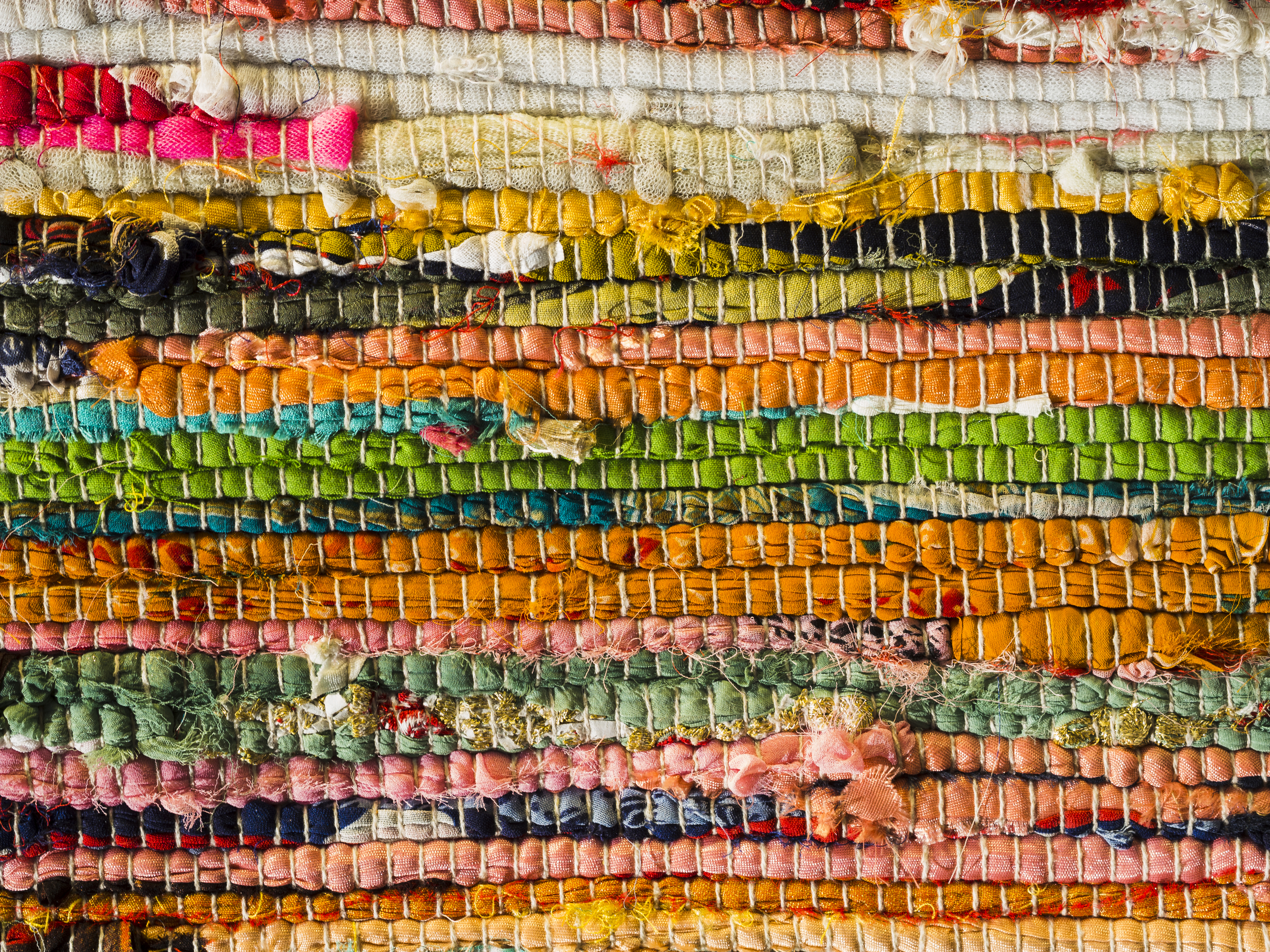
Covoare de Cordele
A centuries-old Romanian craft tradition. Rag rugs woven on wooden looms, turning old fabric into warm, beautiful floors.
.png)
I — The Mountains
In the Carpathian highlands, time moves differently
Far from Europe's logistics corridors and fashion capitals, nestled in the Romanian Carpathians, there are villages where wooden looms still stand in living rooms. Where weaving is not a trend — it's memory. Generations of women have passed down the art of the covor de cordele, the rag rug: strips of old cloth, braided and woven into something sturdy, colourful, and warm.
II — The Women
Over 50. Overlooked. Extraordinary.
In these mountain communities, women over 50 face an impossible reality. Too old for the factories. Too remote for the offices. Too "unskilled" for the modern economy. But their hands carry a skill that no machine can replicate — the ancient, patient art of transforming discarded fabric into woven beauty. They didn't need a second chance. They needed the world to catch up.
III — The Connection
Your unsold garments become their livelihood
When your returned or unsold clothing reaches our facility, it is sorted, graded, and categorised. Items that cannot be resold or donated — stained, damaged, end-of-season — are cut into strips and sent to our mountain workshops. There, the women weave them into rag rugs: unique, handcrafted, traceable pieces. Each rug carries a story — the brand it once wore, the hands that wove it, the village where it was born again.
IV — The Proof
Full traceability. Full compliance. Full heart.
Every garment that enters our downcycling stream is documented. You receive a Digital Traceability Certificate: intake date, weight, condition, downcycling method, workshop, output product. Not just a number in a sustainability report — a story you can tell your customers, your board, and your regulators.
Social Impact in Circular Fashion
Inclusive Textile Downcycling
"To restore the value others have given up on — so that nothing and no one is wasted."
Our fashion circularity operations are embedded in a mountain region of Eastern Europe, an area with limited access to industrial employment. The textile downcycling process is operated by women aged 50+, long-term unemployed individuals, and workers at risk of social exclusion.
.svg)
Stable Local Employment
Direct income for women 50+ in remote Carpathian villages — populations with near-zero formal employment opportunities and no access to urban job markets.
Heritage Preservation & Social Inclusion
Keeping alive the centuries-old tradition of Romanian rag rug weaving while creating economic resilience in rural and mountain communities.
Measurable ESG Metrics
Fashion brands can integrate social impact metrics directly into ESG and CSRD sustainability reporting — jobs created, communities supported, CO₂ avoided.
This allows fashion brands to integrate social impact metrics directly into their ESG and sustainability reporting, creating a measurable link between circular economy operations and social responsibility.
The Process
From Unsold Stock to Circular Value
Collect
Customer returns, unsold inventory, end-of-season overstock — FTL logistics across 27 EU countries.
Sort & Grade
Intelligent triage: resellable garments, reusable textiles, non-resellable waste. Circular pathway optimised.
Prepare
Non-resellable textiles cleaned, cut into strips, colour-sorted and dispatched to mountain workshops.
Weave
Women artisans hand-weave strips on traditional looms into unique rag rugs — each one-of-a-kind.
Certify
Full Digital Traceability Certificate: intake, process, output. ESPR-ready documentation delivered.
Traceability & ESG Compliance
The Paper Trail That Protects You
Under ESPR, you must demonstrate that you took all reasonable steps to avoid destruction. Donation windows, reuse pathways, and documented downcycling are not optional — they are your legal shield.
Our traceability system gives you an auditable, end-to-end record for every garment that enters our facility. From barcode scan at intake to the final product certificate, every step is time-stamped, photographed, and stored.
This is not a sustainability story you tell. It's a compliance file you own.
Intake Manifest
SKU-level or batch-level documentation. Quantities, weights, condition grades, brand identifiers — all logged at reception.
Chain of Custody
From your warehouse to our facility to the mountain workshop. Every handoff documented. No gaps.
Visual Proof
Photographic evidence of sorting, cutting and weaving. Show your auditors and customers exactly what happened.
Digital Certificate
ESPR-aligned traceability report per batch. Ready for annual disclosure, board reporting or DPP integration.
Impact Dashboard
CO₂ saved, kg diverted, jobs supported, rugs produced. Real numbers for ESG filings and CSRD reporting.
Why Partner With Us
Why Fashion Retailers Choose ASAP Reverse Logistics
EU Green Deal Compliance
Full alignment with ESPR textile destruction ban, mandatory disclosure, and upcoming DPP requirements.
Zero Destruction Guarantee
Elimination of clothing destruction and landfill through documented resale, reuse and downcycling pathways.
Full Textile Traceability
End-to-end digital tracking and audit-ready ESG reporting for every kilogram of textile processed.
Improved Recovery Rates
Multi-channel circular routing — resale, reuse, donation, downcycling — maximises value recovery from fashion returns.
No CAPEX Required
Circular economy integration without capital expenditure. Plug into our existing infrastructure across 27 EU countries.
Social & Environmental Impact
Measurable social impact metrics — mountain employment, heritage preservation, CO₂ reduction — ready for your sustainability report.
Who We Serve
Fashion Circularity for Every Scale
Build Your Fashion Circularity Strategy
Whether you operate a multi-country fashion marketplace or a single-brand retail network, ASAP Reverse Logistics enables you to turn regulatory pressure into competitive advantage through compliant, traceable and socially impactful circular economy solutions for textiles.