You did the math. But you forgot a line.
You're a Chinese manufacturer or brand owner. You've built something solid. Your products sell well on JD.com, on Temu, on Wish. Your factory runs. Your supply chain works. And now you're looking west — to Europe — because the margins are better, the brand perception is stronger, and frankly, 500 million consumers with disposable income is hard to ignore.
So you do what smart operators do. You research. You plan. You execute.
You make your marketplace list: Amazon DE, Amazon FR, Amazon IT. Kaufland. Cdiscount via Octopia. Allegro for Poland. eMAG for Romania and the CEE region. Otto if you're ambitious. Trendyol for Turkey. Maybe bol.com for the Benelux.
You hire a global compliance partner — someone like AVASK — to handle your VAT registrations, your fiscal representations, your customs declarations across multiple jurisdictions. And they do a great job, because this stuff is complex and getting it wrong means penalties.
You choose your fulfilment setup. In most cases — maybe 90% — you go with the marketplace's own fulfilment network. Amazon FBA, Kaufland's warehouse programme, whatever gives you the Prime badge or the fast-delivery tag. Or you pick a third-party logistics centre. Either way, your goods are sitting in European warehouses, ready to ship.
You build your listings. You set your price policy. You calculate:
"My landed cost is €5. I sell at €50. After marketplace fees, fulfilment, VAT, compliance — I still make good money."
And you feel good. You should. You've done more homework than most.
But there's a line missing from your spreadsheet.
The 5% That Isn't 5%
Every experienced cross-border seller will tell you: returns are a small percentage. Maybe 3–5% on average, depending on category. For furniture and home goods, it can hit 15–25%. For fashion, even higher.
You already knew this. What you didn't calculate is what happens to those returned products once they land back in a European warehouse.
Let's walk through the reality:
Your customer in Berlin orders a shelf unit. It arrives. Maybe a panel is scratched. Maybe it doesn't match the room. Maybe they just changed their mind — which, under EU consumer law, they're entitled to do within 14 days, no questions asked.
The product comes back to the fulfilment centre. Now what?
Shipping it back to China? Forget it. The customs duties alone would make it absurd. The freight cost exceeds the product value. No one does this.
So the product sits. And here's where it gets expensive:
The fulfilment centre charges you storage fees — daily, weekly, or monthly — and those fees go up over time
If you don't act, they'll eventually flag it for disposal — and charge you a disposal fee
In many warehouses, what actually happens is even worse: a well-connected employee takes those "disposed" goods, sells them privately, pockets the cash — and you still pay the disposal invoice
Meanwhile, you've already absorbed the original manufacturing cost, the shipping cost to Europe, the customs duty, the marketplace commission on the original sale (which gets clawed back on return), and often a return shipping fee
That "5% return rate" just turned into a real loss line that nobody in your finance team is tracking properly.
And we haven't even talked about slow-moving inventory yet.
The Dead Stock Problem Nobody Wants to Discuss
Not every product you send to Europe will sell fast. Some won't sell at all.
This isn't a quality issue. It's a market fit issue. A product that flies off the shelves in Guangzhou might sit untouched in a German warehouse because the colour doesn't work in European interiors, or the sizing is off, or the timing is wrong, or the listing doesn't communicate the right value proposition for a European buyer.
Cultural differences are real. What reads as premium in one market reads as cheap in another. What's functional in Asia might be missing a feature that European consumers consider standard. This is normal. It happens to every cross-border seller.
But while the product sits, it costs you money. Storage fees accumulate. Capital is locked. And the longer inventory sits unsold, the harder it becomes to move — because marketplace algorithms penalise slow sellers with lower visibility, creating a death spiral.
Most sellers handle this by slashing prices — which destroys your brand positioning and trains customers to wait for discounts. Or they eat the loss and write it off.
Neither option is good business.
Turn the Liability Into a Revenue Line
Here's what the smart operators are starting to figure out: returns and slow-moving stock are not a cost centre. They're a revenue opportunity you're currently giving away to someone else.
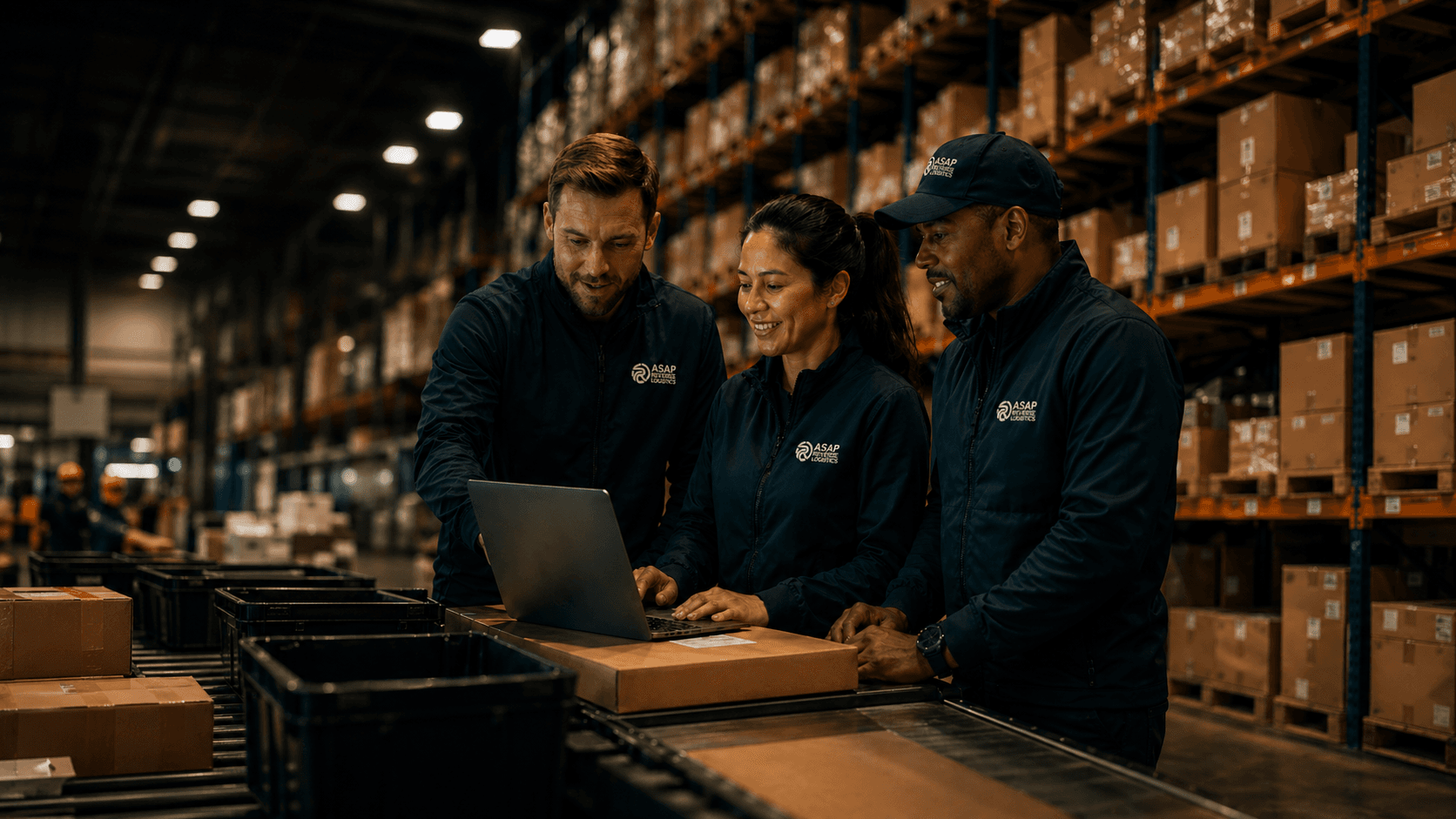
This is what we do at ASAP Reverse Logistics.
We are a European recommerce operator. For over 16 years, we've been handling exactly this problem — not in theory, but in practice, at scale, across multiple product categories: furniture, home appliances, consumer electronics, general merchandise.
What we actually do with your returns:
We collect them from your European fulfilment centres. We grade every single unit — not with a rubber stamp, but with documented, SKU-level assessment. Grade A products (fully functional, original packaging) go back to market at near-retail prices. Grade B (cosmetic imperfections, functional) get sold through our multi-channel network. Grade C and below get processed responsibly — parts recovery, recycling, compliant disposal.
The numbers that matter:
We recover 32–40% of original product value on average. The industry standard is 8–15%. Read that again.
Average time from intake to cash: 21 days. Not 21 weeks. Days.
Every unit gets a documented manifest — you know exactly what happened to every product, which matters for your accounting and for EU compliance.
What we do with your slow movers:
This is where our 16 years of European market experience becomes your advantage. We know buyers. We have 65,000+ B2B clients across Europe who buy exactly this type of inventory — graded, manifested, priced to move. We know which buyer in Poland wants your kitchen appliances, which wholesaler in Spain is looking for your furniture line, which B2C channel in Romania will clear your home textiles within a week.
We don't guess. We match your stock to the right buyer, in the right market, at the right price. Because we've been doing this longer than most of your marketplace competitors have existed.
Why This Matters More Than You Think
In Chinese business culture, there's a principle that resonates here: 不积跬步,无以至千里 — without accumulating small steps, you cannot travel a thousand miles.
The returns problem feels small. Each individual return is a minor irritation. But accumulated across thousands of units, across multiple marketplaces, across a full year of European operations — it becomes the difference between a profitable European expansion and one that looks good on the top line but bleeds cash underneath.
The sellers who will win in Europe over the next five years are not necessarily the ones with the lowest manufacturing costs. They're the ones who control the full lifecycle of their product — including what happens after the first sale doesn't stick.
Every product that gets disposed of instead of resold is value you created and then destroyed. Every slow-moving unit that sits in storage for six months is capital that could be working somewhere else. Every return that gets "handled" by a warehouse employee's side hustle is money leaving your business through a hole you didn't even know existed.
A Practical Next Step
We're not asking you to change your entire European operation. We're asking you to look at one number: what are your European returns and slow-moving inventory actually costing you right now?
If you don't know the answer — and most sellers don't, because it's scattered across marketplace reports, fulfilment invoices, and accounting write-offs — that's already a problem worth solving.
We offer a free assessment. No commitment, no sales pitch. We look at your current European volumes, your return rates by marketplace, your inventory ageing, and we give you a clear picture of what you're losing and what we can recover.
That's it. Just clarity. And then you decide.
Because in the end, this isn't about logistics. It's about whether you're willing to leave money on the table — or whether you'd rather pick it up.
Contact us:
📧 [email protected] 🌐 www.asapreverse.com
ASAP Reverse Logistics — Restoring the value others have given up on.